Showing posts with label nana. Show all posts

27 February 2021

10 Years

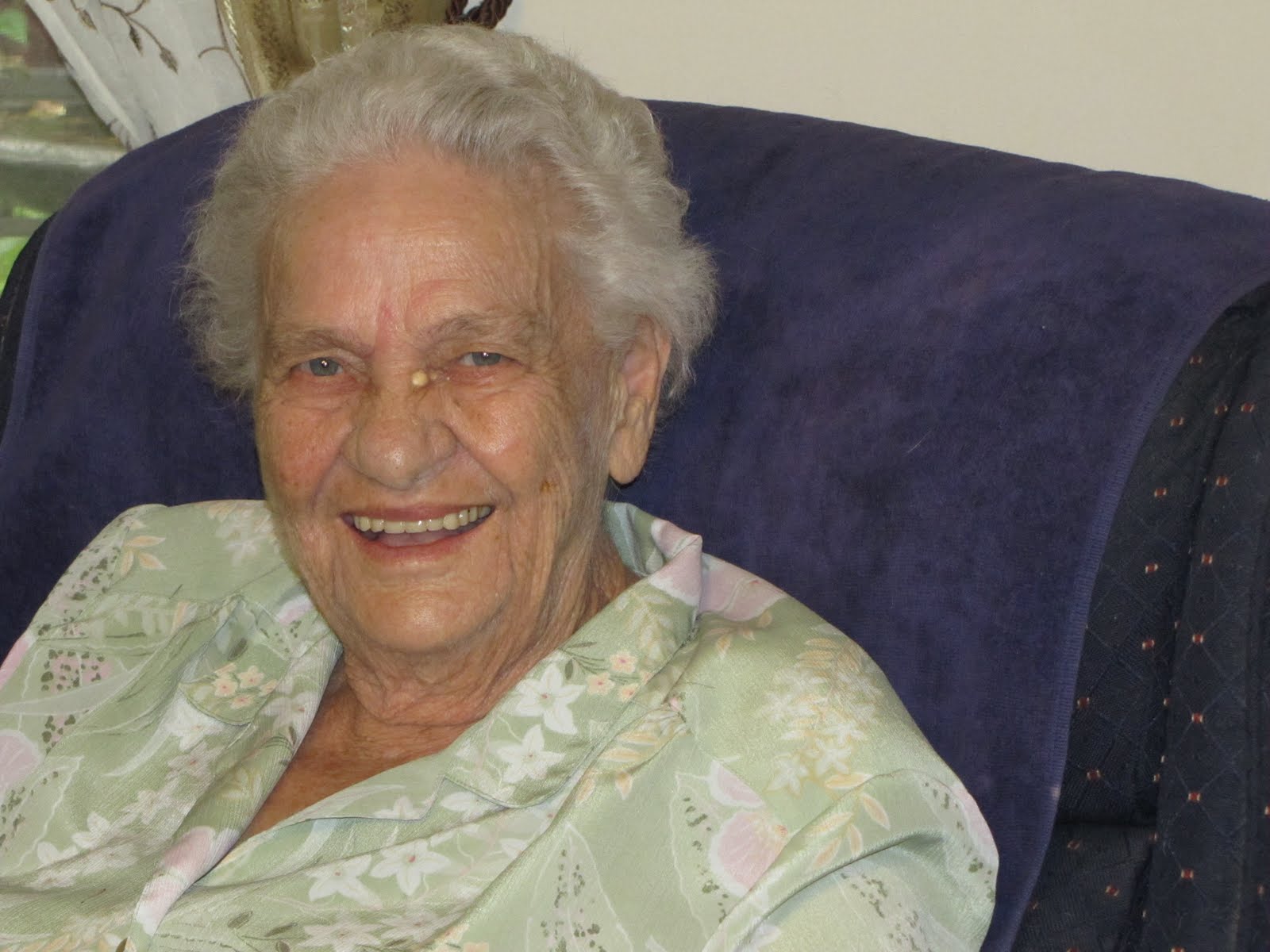
Nana, with a twinkle in her eye
photo by me

It has been 10 years since Nana, my grandmother, died. I've written about her before, and I've been thinking about her a lot lately. With 500,000 people dead from COVID in the past year, death is close to many people.

I am glad I have not had to worry about Nana getting COVID. I am glad I have not had to fight to get her vaccinated. I am glad she did not have to see the callousness of the Trump Administration toward the sick and grieving.

But that does not mean I am glad she's not here.

I miss her so, so much. I miss talking with her about my day. I miss her undying support and belief in me.

I miss her teasing, her laughter, her smile. I miss hearing her talking on the phone with her friends.

Because she lived with us all of my life, I have so many more memories of her than I do of Daddy and Papaw.

Once, when I was still in high school, a friend of mine and I drove to a nearby town to go to Walmart. Nana was also in that town running errands, and she spotted us in Walmart. Her face was bright with excitement, and she almost ran to us.

"Guess what," she asked us.

"What?" we said.

"I was just in a car wreck," she said, grinning from ear to ear.

Naturally, my friend and I were horrified.  "Are you hurt? What happened?"

"Oh, this woman hit the back of my car, and I spun in a circle through the intersection."  She moved her hand in a circular motion, still grinning.

Nana still watches over me
photo by Mom

"But you're okay?" I asked.

"I'm fine." Then, she looked at me and said, "Oh, Sara, that was fun."

That was Nana.  The kind of person who could be involved in a simple car accident where no one was hurt and see the positive.

When I hit a deer driving home at night that winter, she only wanted to know if I was okay. After I assured her that I was, and that the deer had even run off, seemingly unhurt, I said, "I don't think the car is damaged either."

"I don't care about the car, Sara. Cars can be replaced. You can't."

She could put things in perspective like no one else, and that has helped me deal with all the stress of the things she's missed over the last 10 years.

Also, after hitting that deer, she teased me about it. "If you see a deer limping around here, that's the one you hit." Her eyes danced when she said it.

That sense of humor has helped me deal with her loss, too.  But I still miss her.

28 September 2018

My Grandmother’s #MeToo Trauma

My grandmother in the 1940s or 1950s.
photographer unknown
This is a hard post for me to write. I struggled about whether or not I should even write this, but I think I should.

With all the talk the past year or so about sexual harassment, sexual assault and rape, I've been thinking a great deal. The discussions haven't brought up any trauma for me. Like every woman, I've been subjected to harassment. This is not to deny that those injustices should be ignored but merely to state that I am okay.

This post isn't about me.

This is about my grandmother.

She passed in 2011, and I miss her every day. About six or seven months before she passed, she entrusted me with a secret.

She had been molested and raped as a child and teen.

She didn't tell me the gory details, and I didn't ask. She didn't tell me names, though I have no doubt she remembered them. Suffice it to say, she knew her attackers.

Even she wasn't sure if everything that had been done to her "counted" as something wrong. She asked me that when talking about the man who took her into a room as a child and did things to her. "Now, isn't that wrong?"

I told her yes, it was. I said that with absolute conviction because it is true.
My grandmother in the mid-1980s
in San Antonio.
photo by my mother

I don't know how I kept from crying when she told me that. I'm crying typing this right now.

The point I want to make here is not to name the men who hurt my grandmother; I don't know their names. The point is not to damage the way people remember my grandmother; they have their own memories of her to recall.

The point is that that trauma lived with my grandmother for the rest of her life.

She lacked confidence in herself. She considered herself “stupid” (her word, not mine).

These things I knew long before I knew about her assaults. I always thought they were a result of bullying behavior by siblings or the fact that she had to quit school in sixth grade. And I'm sure that's part of it, too.

But it all boils down to the shame she lived with every day for most of her life.

My grandmother and grandfather at their
40th wedding anniversary.
photographer unknown
As far as I know, the only person she told was her husband.

People who have been assaulted sexually are forced to deal with that shame and trauma every day. Some are able to talk about their experiences almost immediately, and some are not. Some are lucky enough to see their attackers serve time in prison. Most are not.

The revelations and news about sexual offenders that has come out over the past years has been infuriating, heartbreaking and depressing. I do not know how my grandmother would have responded to all of these revelations. Would they have brought back painful memories? Would she have told me more details? Would she have reached out to someone for help?

I like to think she would appreciate me writing this post for her as a way to exorcise some of her demons. I hope that's true.

If you or someone you know has been sexually assaulted and needs help, please contact RAINN.

You can also donate to RAINN.

03 March 2011

The Funeral

Nana's funeral was held March 2 at the Second Baptist Church in Angleton.

We had a slideshow of pictures playing during the viewing and asked people in attendance to speak, if they wanted, during the funeral.

Several friends and family members spoke. They talked about Nana's unselfish spirit, her smile, her loving heart, and her spiritual legacy.

I read part of a story I wrote. Several years ago, I wrote a novel based upon incidents Nana told me about her childhood. While the story is fiction, the idea for it – Nana's first visit to a movie theater – is true.

Although there were more than a hundred people in attendance (we ran out of programs!), some were unable to come. I had some requests from people to read the story, so I thought I would post it here.

The set-up is simple. Mama has Alverda (that's Nana!) and Alverda's brother Ellery to go into town to retrieve another brother, Leard, from the movie theater.

Enjoy!

A Powerful Picture
by Sara K Joiner
When Mama pulled up in front of the theater, Alverda gazed in awe at the white building. What went on behind those doors? she wondered.
“Alverda, run inside and get Leard,” Mama told her.
Her mouth dropped open. She was going to find out! She was actually going to learn what went on behind those doors!
“Come right back out,” Mama instructed.
“Yes, ma’am,” Alverda answered and was out the door of the pickup truck quick as a minute.
She strutted up to the doors of the theater her thumbs hooked under the straps of her overalls.
“Excuse me,” the man who sold the tickets said. “Where are you going?”
“My mama told me I have to get my brother,” Alverda explained. “He’s inside at the picture show. He’s got to go home and do his chores.”
“I reckon it’s all right if you go in there, but make sure you come right back out, ya hear?” he said.
“Yessir,” Alverda replied.
When Alverda opened the doors, she walked into the theater’s lobby.
The buttery popcorn smelled delicious. Alverda wished she had some money to buy herself a Coke.
“Hello, little girl,” a woman behind the popcorn and soda booth said.
“I’m not a little girl,” Alverda insisted.
“Of course you’re not,” she said. “Do you want a Coke?”
“Yes, ma’am,” Alverda answered. “Only I don’t have any money.”
“Honey, no one has any money,” she said with a sigh. “Let me get you a Coke anyway.”
“Thank you, ma’am.”
“You’re welcome, honey,” the woman said as she handed Alverda a Coke. “Enjoy The Kid.”
“What kid?” Alverda asked.
“That’s the name of the picture, honey,” the woman replied. “Enjoy it. It’s a good one. Charlie Chaplin’s in it and that cute little Jackie Coogan.”
“Oh, I’m not going to the picture show. I have to get my brother. He has to do his chores, Mama said,” Alverda explained.
The woman laughed. “You’re the talkingest girl I ever met,” she said. “You better go get your brother or your mama might get angry.”
“Yes, ma’am,” Alverda said. “And thank you again for the Coke.”
She managed to push the heavy, wooden doors to the picture show open without spilling her drink and found herself in a room that was much darker than the lobby.
The only light came from a huge screen at the front of the room with hundreds of seats facing it. People sat in the seats staring at the screen.
A man sat beside the screen playing very sad music on a piano. On the screen, a little boy was sobbing and stretching out his arms toward a man who looked like a tramp. The little boy was crying, and the tramp was too.
“Why doesn’t that little tramp help that boy?” Alverda asked. Her voice sounded very loud in the group of quiet people.
“Shh,” voices around her whispered.
Someone in the audience got up from the seat.
“Alverda, what are you doing here?” Leard whispered as he walked up to her.
“Mama said to come get you. You have to do your chores,” she told him.
“Shh” came from the audience again.
“You have to whisper,” Leard said. “And the picture ain’t over yet.”
Alverda just gazed at the screen. “Why doesn’t that little tramp help that boy?” she asked again, whispering this time just as Leard told her.
“The boy is an orphan and the tramp has been taking care of him,” Leard explained. “Now the police are taking the boy away, and they won’t let the tramp come with them.”
“Oh,” Alverda said. She walked to the nearest seat and sat down. Leard sat beside her.
“How come we can’t hear them talking?” Alverda asked.
“You can’t hear talking in any picture shows,” Leard told her. “I read in a magazine that people are making movies where people’s voices can be heard, but I ain’t never seen one of them.”
“Oh,” Alverda said again. “How come everything’s grey?”
“What do you mean?”
“All the people and the clothes and stuff. It’s all grey.” She could not take her eyes off the screen.
“It’s called black and white, Alverda. Just like in photographs. No movies have color. Don’t you know that?” he asked.
“No,” she said. “I’ve never been to the picture show before.”
Minutes passed, but it seemed like hours. So much was happening on the screen!
Then Alverda felt a tap on her shoulder. She looked around. Ellery was standing behind her.
“I came to get the both of you,” he whispered. “Mama’s madder than a hornet. We’ve been waiting out there for twenty minutes. Let’s go!”
“All right, Ellery,” Leard said. “We’ll go. Maybe I’ll get to see this picture some other time.”
All three of them left the theater while Alverda wondered if the little tramp would be able to get the boy back. Thinking about that little boy made Alverda sad. What would she do if Mama and Daddy weren’t there to take care of her? She didn’t want to think about it.
“Leard, we should pray for that boy to be given back to the little tramp,” she suggested.
Leard and Ellery burst out laughing. “Silly, the picture show’s fake. That boy has a mama and a daddy in real life, and the tramp has nice clothes and lots of money. It’s fake. It’s not real,” Leard said.
“So, we don’t need to pray for them?” she asked, trying hard to understand.
“No,” Ellery said. “It’s not real. They’re doing just fine.”
“I didn’t know! I’ve never been to the picture show before,” she told him.
“Well, if you want to pray for somebody, pray for us,” Leard said. “We’re the ones who need help. No rain, no crops, and no money. All we’ve got is prayer.”
The three of them walked up to the pickup truck and climbed inside.
“What took you so long?” Mama demanded.
“You sent the wrong person in to get me, Mama,” Leard said. “Alverda’s never been to the picture show before. She sat down to watch for a while after she found me. We would’ve left sooner if not for that.”
“Don’t you blame your sister, young man. You should have left when she told you. You know better than to cross me,” Mama said angrily. “I can’t believe I had to send Ellery inside to get both of you. You’re lucky I don’t turn you and Alverda over my knee.”
“Mama, I’m too big for a whuppin’,” Leard said.
“Not yet you aren’t,” she reminded him. Then she eyed her daughter. “Where did you get that Coke?”
“Yeah, where?” Ellery asked.
“Hush,” Mama said. “Well, Alverda?”
“The lady inside gave it to me,” she explained.
“Did you ask for it even though you don’t have any money?” Mama wanted to know.
“No, ma’am,” Alverda answered, shaking her head. “She said I was the talkingest girl she ever met, and she gave me a Coke.”
“Well, you got that right,” Leard said. “You are a talker.”
“I’d rather be a talker than someone who doesn’t do my chores,” she told him.
“Did you hear that, Leard?” Mama asked. “She just told you what’s what.”
Mama started the dusty truck and drove back to the farm. Alverda kept thinking about the little tramp and the boy. She hoped everything turned out all right for them.
I think I’ll say a prayer for them anyway, she thought to herself, no matter what Leard says.
As Mama turned the pickup truck into the drive, Alverda thought, if the picture isn’t real, why am I so worried about the tramp and the boy? Right then, she understood that the picture show was a powerful thing.
The names are true, as well. Nana's middle name is Alverda, which I've always found fascinating because it sounds so old-fashioned and Southern. And she did have two brothers named Leard and Ellery.

27 Days

My last post described my grandmother's failing health.

Not long after I wrote that post, she passed away. I wish I could say she went to sleep and died peacefully.

She did not.

She went downhill very quickly. Plummeted is a better description.

Tuesday, the day after Presidents' Day, she was placed on hospice for her COPD. They were hoping that they would have her condition and medications stabilized at the end of the 90-day hospice period.

Friday morning she ate a full breakfast. Friday afternoon her pastor stopped by for a brief visit. Friday night, she was bedridden and unable to walk.

Mom and I slept in the study with Nana in a trundle bed on the floor. It was the longest night of my life.

Saturday we got her in a nursing home. The hospice nurse tried arranging 24-hour care for her, but it was a weekend. She had difficulty finding people to work.

On Sunday, a number of friends and family came by the nursing home to see her. She was unconscious and in a coma. The only medications she was receiving were to maintain her comfort.

Sunday night, after Mom and I returned home, her nephew called us and told us she had passed. It was about 11:30 p.m.

Earlier in February, Nana had told Mom that she had only 27 days left. She died on February 27, twenty-eight years and six days after her husband.

11 February 2011

When Reality Makes No Sense

I haven't written here in quite some time, and now I've chosen to write a difficult post.

My grandmother is not doing well.

Short though that sentence is, it is very hard to write. I hate admitting that she's not herself anymore. Or, rather, she's herself as if visiting from an alternate reality. Sometimes.

For those of you who haven't met my grandmother, let me introduce you to her. She is known by many names - Carrie, Verda, Nanny, Meemee. To me she is Nana. But she is more than that. She is the woman I consider my grandmother. She is not related to me by blood, but I am more like her than I am some of my blood relatives.

When I was born, I had only one living biological grandparent - my mother's mother. She died before I turned one.

Nana was a friend of my father's family. Nana and her husband (Papaw) never had any children of their own, but they helped raise nineteen children, including me. When my parents moved to the farm, Nana and Papaw sold their home and moved to the farm with us.

Papaw died when I was six, and Daddy died two years later. For a very long time, it's been me and Mom and Nana. We're a family.

Nana took me to church. Nana taught me how to make hot chocolate and fried toast. Nana taught me how to pay bills.

Three weeks ago, she had an episode. She couldn't find her bedroom and didn't know where she was. I thought, because she has COPD, that she needed oxygen from her tank. We hooked the tube under her nose, and she was back to her normal self in about forty-five minutes.

When I came home from work that day, Mom said Nana got mad at her at lunchtime for not bringing food for the men working on the house. There were no men working on the house. Only Nana saw them and even called one of them by name.

The next day was worse.

The next day she seemed fine, but on the advice of her doctor, we took her to the emergency room at Methodist Hospital.

She was admitted and spent a week in the hospital getting test after expensive test run with no real diagnostic result. One doctor said TIAs, one said dementia, one said seizures.

Mom and I believe TIAs.

Nana is now home. She is not better. The arthritis, sciatica and pinched nerves in her back, hips and leg - which she has had for years and months, respectively - is worse. The itch she has over her entire body - which she has had for more than a year - is worse than ever causing her to scratch and bleed almost constantly.

And the hallucinations and delirium and confusion continue. She still sometimes cannot find her room. She still sometimes sees people in the house. She tells me stories about riding on the railroad and helping to make beds on the train cars. She thinks this happened. And she thinks this happened recently.

I treat her comments as if they're true, unless I need to make a correction.

Her sense of humor is still there. Her mischievous smile. A bit of the sparkle has left her eyes though, and she knows something is wrong.

She cannot be left alone.

I wish I could help her. I wish there was something I could do. She's my Nana. I love her.